What's new
Christian Community Forum

Register a free account today to become a member! Once signed in, you'll be able to participate fully in the fellowship here, including adding your own topics and posts, as well as connecting with other members through your own private inbox!

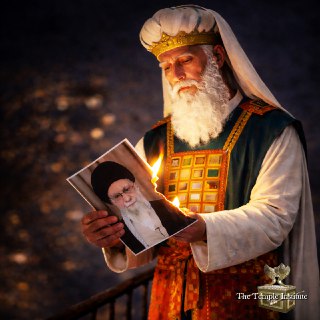
Priestly and Levite guilds prepare for Temple revival

Jedidjah

Active
JNS: Priestly and Levite guilds prepare for Temple revival

"An emerging effort to revive the Aaronite priests and Levitical assistants of ancient Israel has grown into a nearly 100-strong professional community of Kohanim and Levites ➡️ in just a month, led by a young Israeli doctor and Temple Mount activist. To that end, the communities collaborate with groups such as the Temple Institute, whose altars and ritual equipment could, in Huberman’s telling, be deployed rapidly if circumstances allowed, making a pool of trained Kohens and Levites a strategic religious asset."

———————
✝️⏰ Revelation 1:3 Blessed is he who reads and those who hear the words of the prophecy, and who keep the things which are written in it; for the time is near.
 
"The Temple Institute, with every fiber of our beings, supports the brave Iranians who have courageously risen up against their tyrannical Islamic oppressors. We pray for the safety and success of the people of Persia as they pursue freedom at all costs. We remember the historic act of liberation by Cyrus, king of Persia, who told the Jews under his reign to go home to Jerusalem and rebuild the Holy Temple.

A liberated Iran today would immediately renew these ancient bonds of friendship between the people of Israel and the people of Iran/Persia, and surely pave the way for the rebuilding of the Holy Temple in our day, "a house of prayer for all nations!" (Isaiah 56:7)"

 
What I find interesting is that the temple in Daniel 8:11 is called “the place of his sanctuary.”

In Matthew 24:13, the Lord Jesus speaks of "the holy place." And in 2 Thessalonians 2:3-4 and Revelation 11, it is referred to as "the temple of God."
 
What I find interesting is that the temple in Daniel 8:11 is called “the place of his sanctuary.”
Here’s a different version: Daniel 8 Brenton's Septuagint Translation
“And this shall be until the chief captain shall have delivered the captivity: and by reason of him the sacrifice was disturbed, and he prospered; and the holy place shall be made desolate.”

This chapter foretells the first abomination of desolation by Antiochus IV Epiphanes who sacrificed a pig in the second temple and gave us Hanukkah.
He did make the holy place desolate.

The third temple will be thought of as God’s, but zealous Jews debate whether it should be built to welcome the coming Messiah, or wait to build it after Messiah comes for the first time. Either way, it is Jesus they are rejecting.

I’m curious about why you are trying to claim that the third temple is God’s?
 
Related commentary that some may find helpful: Daniel 8 Cambridge Bible for Schools and Colleges

“Daniel 8:11. And even unto the prince of the host it magnified itself, it not only mounted to the stars, but in impious defiance it shewed greatness (Daniel 8:4; Daniel 8:25), i.e. continued its acts of pride and presumption, even to the throne of the prince of the host, i.e. of God himself.

and it took away from him (i.e. from the prince of the host) the continual (burnt-offering). So the Heb. text (K’tib): the Heb. marg. (Qrê) has, and by it the continual (burnt-offering) was taken away. The allusion is to Antiochus’ suspension of the temple-services for three years (1Ma 1:45; 1Ma 1:59; 1Ma 4:52 f.); see further on Daniel 11:31.

The daily burnt-offering is called in Exodus 29:42 and elsewhere the ‘continual (i.e. daily recurring) burnt-offering,’ lit. ‘the burnt-offering of continuance (Heb. tâmîd)’: from this expression, the daily burnt-offering came in later Heb. to be spoken of simply as ‘the tâmîd’; and this usage is found here, and in Daniel 8:12-13, Daniel 11:31, Daniel 12:11. It does not occur elsewhere in the O.T., but it is common in the Mishna, &c., where the word is even used in the plural, ‘the tâmîds’ (תמידין).

and the place of his sanctuary was cast down, or, by a change of points, which has the effect of improving the sentence, and cast down the place. The Temple does not seem to have been literally ‘cast down’ by Antiochus: but it suffered severely at his hands: its sacred vessels were carried away (1Ma 1:21-23); the sanctuary is described as being ‘laid waste like a wilderness (8:39), and ‘trampled down (καταπατούμενον)’ (1Ma 3:45); and in 1Ma 4:38 we read that when Judas and his brethren went up to mount Zion for the purpose of re-dedicating it, they ‘saw the sanctuary laid desolate, and the altar profaned, and the gates burned up, and shrubs growing in the court as in a forest or in one of the mountains, and the priests’ chambers pulled down’ (cf. 8:48, ‘and they built the holy place (τὰ ἅγια), and the inner parts of the house’).

[place] not the usual word, but a rarer word, chiefly poetical, and meaning properly fixed or established place, used mostly of God’s abode, whether on earth, Exodus 15:17, 1 Kings 8:13, or in heaven, Isaiah 18:4, 1 Kings 8:39; 1 Kings 8:43; 1 Kings 8:49, Psalm 33:14, al.”

Here’s another one: Daniel 8 Pulpit Commentary

“Verse 11. - Yea, he magnified himself even to the prince of the host, and by him the daily sacrifice was taken away, and the place of his sanctuary was cast down. This is said by Bevan to be the most difficult verse in this whole book.

There is a difference here between the Q'ri and the K'thib. The latter reads הרים, the hiphil of רום, while the former reads הרם, the hophal of the same verb At first sight the difficulty is not lessened by consideration of the versions. The Septuagint as it at present stands is utterly unintelligible, "Until the leader of the host shall save the captivity, and by him everlasting mountains were broken down, and their place and sacrifice taken away, and he placed it in the very ground, and he prospered [reading with Syriac] and was, and the holy place shall be laid waste." This confusion is due to confluence of readings, and is not difficult to disentangle with the help of the Massoretic text. Up to the last two words the Septuagint is a translation of a text differing from the Massoretic simply by intelligible variations and repetitions not uncommon in the Septuagint. The first clause of the LXX. originally was probably, "Till the prince shall deliver the captivity," reading שְׁבִי(shebee) instead of צַבָא (tzaba) - a scribe, finding צבא in his Hebrew, then added the translation of it to the margin of his Greek copy, from which it got into the text. The original of the LXX. had also יַצִּיּל (yatztzeel) instead of הִגְדִיל(hig'deel) - a confusion easily made in the elder script, in which י and ה were like. We learn from the Talmud (Shabb., 103b) that ג was liable to be mistaken by scribes for צ. Moreover, "captivity" would naturally suggest נצל, "to deliver." The second clause is, "By him the everlasting mountains were broken down." Here hayreem has been read with the K'thib, and vocalized as if it were hareem, and tameed, "continual," translated as equivalent to עולם ('olam), "everlasting."

The next clause reveals the other meaning of tameed, "sacrifice," which probably had been written on the margin, and then dropped into the text. The latter part of the Septuagint verse appears to be confused with the latter part of the following verse according to the Massoretes. Theodotion is even less intelligible than the Septuagint, "Until the leader of the host shall save the captivity, and through him the sacrifice was broken down, and he prospered, and the holy place shall be made desolate." It is to be noticed that the first clause here agrees with the LXX. It is possible that "and he prospered" is a doublet, הִצְלִיַח being read for חֻשְׁלַד in some copy. The Peshitta differs from both the Greek versions, "Until it arrive to the chiefs of the host, and by it was set up in perpetuity, and preparing he strengthened the sanctuary," and while it is difficult to understand the origin of the variation in the first clause, it is clear that in the second clause the translator must have read hish-leem for hooshlak. The one thing that seems clear is that the reading of the K'thib is to be preferred. We should read hayreem, not hooram. Only the first of these could be read "mountains." If we translate the words as they stand, we shall certainly be removed out of the region of all the commentators. It is assumed that "the little horn" is the subject of this sentence; but "horn" is feminine in Hebrew, and the verbs here are in the masculine; this is against it being the nominative. The "prince of the host," then, must be the nominative of the verbs and subject of the sentence. The rendering of the first clause ought to be, then, "Until the prince of the host magnify himself (1 Samuel 12:24), and by himself he shall offer the daily sacrifice. And he shall cast down the foundation of his holy place," reading hishlayk instead of hooshlak.

We should feel strongly inclined to transfer the first "and" to hayreem, and, changing the punctuation, read, "Until the prince of the host shall make himself greater than he" - viz, the tyrant represented by "the little horn" - "and shall offer the daily sacrifice." If we might read hishleem with the Peshitta instead of hoosh-lak, we get a satisfactory meaning to the last clause, in which case we should render, "He shall complete the place of his sanctuary." We would understand by "complete," "to perfectly purify."

Taking the Massoretic text thus with little modification, we have a description of the successes of Judas Maccabseus, who was prince of the host, and as such became stronger than Epiphanes, and then cleansed the temple, and offered the continual daily sacrifice. We give, as a curiosity, the note of Saadiah Gaon: "The King of Ishmael was more powerful than the kings of Rome who had Jerusalem, and he took Jerusalem from them by force."

 
the holy place

The near fulfillment of this prophecy was realized especially under Antiochus Epiphanes. That the conflict between the Greco-Syrian Empire and the Jewish state did not exhaust this prophecy is evident from Gabriel's statement to Daniel: "Understand, O son of man; for the vision belongeth to the time of the end" (v. 17). This thought is repeated in verse 23: "And in the latter time of their kingdom, when the transgressors are come to the full, a king of fierce countenance, and understanding dark sentences, shall stand up," and we are again told that this vision belongs to the time to come: "for it belongeth to many days to come" (v. 26). There can therefore, be no doubt concerning this prophecy that it had a near fulfillment in the case of the conflict between the Medo-Persians and the Greeks and the Hebrews, and that it blends with one pertaining to the end time.

Your second question I don't understand, because I simply quoted three passages from the Word of God. When the Lord Jesus Himself calls it “the holy place,” I take Him at His word. When Paul calls it “the temple of God,” I certainly don't question that.
 
I’d like to emphasize part of the Pulpit Commentary:
The rendering of the first clause ought to be, then, "Until the prince of the host magnify himself (1 Samuel 12:24), and by himself he shall offer the daily sacrifice. And he shall cast down the foundation of his holy place," reading hishlayk instead of hooshlak.
(I wish one day to grasp Hebrew $ Greek better, but I think it’s easy to understand that our translations of Daniel 8:11 are not the best.)
 
Your second question I don't understand, because I simply quoted three passages from the Word of God. When the Lord Jesus Himself calls it “the holy place,” I take Him at His word. When Paul calls it “the temple of God,” I certainly don't question that.

Once the third temple is built, the sacrificial system of the Mosaic Law will be reinstituted. However, this temple receives no sanction from God. This is clear from Isaiah 66:1-6:

1 Thus says Jehovah, Heaven is my throne, and the earth is my footstool: what manner of house will ye build unto me? and what place shall be my rest? 2 For all these things had my hand made, and so all these things came to be, says Jehovah: but to this man will I look, even to him that is poor and of a contrite spirit, and that trembles at my word. 3 He that kills an ox is as he that slays a man; he that sacrifices a lamb, as he that breaks a dog’s neck; he that offers an oblation, as he that offers swine’s blood, he that burns frankincense, as he that blesses an idol. Yea, they have chosen their own ways, and their soul delights in their abominations: 4 I also will choose their delusions, and will bring their fears upon them; because when I called, none did answer; when I spoke, they did not hear: but they did that which was evil in my eyes, and chose that wherein I delighted not. 5 Hear the word of Jehovah, ye that tremble at his word: Your brethren that hate you, that cast you out for my name’s sake, have said, Let Jehovah be glorified, that we may see your joy; but it is they that shall be put to shame. 6 A voice of tumult from the city, a voice from the temple, a voice of Jehovah that renders recompense to his enemies.

The passage begins with a protest from God, who makes it clear that no temple built by Israel at this time will be acceptable. God will not come and reside in it (v. 1) as He did in the first temple. Instead of a temple, God will require faith (v. 2). He will not accept the reinstituted Levitical sacrifices any more than He would accept human sacrifices, swine, or idolatry in Old Testament times (v. 3). The very fact that the Jewish people will build this temple shows their failure to listen to God’s Word and come to Him by faith in Yeshua the Messiah (v. 4). There will be a remnant, meaning faithful Jews, who will not participate in the rebuilding of the temple for the tribulation (v. 5) but are seeking to do God’s will. Finally, this new temple will only end in judgment (v. 6) and not in forgiveness of sin or acceptable worship.

Summarizing the verses, Isaiah spoke of a temple being built that God would not sanction. The verses cannot refer to Solomon’s Temple or the temple built by Zerubbabel, because God did sanction both; nor can they refer to the Millennial Temple, which will be built by Messiah and which will certainly be sanctioned by God. Therefore, the only temple that this could refer to is the Tribulation Temple. So, Isaiah the prophet foresaw the building of a temple that God would not sanction. He wanted Israel to return to Him in faith, not merely to build Him a house.

The above is taken from Footsteps of the Messiah, by Arnold Fruchtenbaum.
 
The third temple seems to have mixed reviews in the Bible. On the one hand the third temple is referred to as “the temple of God” and the “House of the Lord of Hosts” in the Scriptures, but on the other it will not be built by Spirit-filled believers, and it will at some point become the seat of the antichrist.

Hebrew texts such as Isaiah 2:2–3, Micah 4:1–2, Daniel 9:27 and Zechariah 14:20, speak of the third temple, as well references in the New Testament such as 2 Thessalonians 2:3-4 and Revelation 11.

In the first few verses of Revelation 11, the angel tells the Apostle John as he is being shown what is to come,

“Rise and measure the temple of God and the altar and those who worship there, but do not measure the court outside the temple; leave that out, for it is given over to the nations, and they will trample the holy city for forty-two months.” (Revelation 11:1b-2)

The angel describes it as “the temple of God”, and says there’s a court outside for nations other than Israel. There is a time limit to this trampling, and it all seems to be happening towards the end of time itself. The two witnesses are in the vicinity, prophesying in God’s authority for 1,260 days (equivalent to 42 months).


There's some interesting conjecture in this article.
 
I personally distinguish between what we are told in Revelation 11,1, because we know that there will be a remnant—even in Jerusalem.

I think we may say that throughout the Bible when God speaks of measuring anything the thought is implied that He is marking it off as that which belongs to Himself. The angel called on him to “Rise, and measure the temple of God, and the altar, and them that worship therein”. That is, once more God acknowledges a witnessing company, a worshiping people in Jerusalem.

"We are here at once in the centre of prophetic subjects Jerusalem, the temple, the altar, and worshipers. The worshipers and the altar are recognised and accepted of God those worshiping in the secret of God within. The general profession of Judaism is rejected and disowned. It is given up to be trodden down under the Gentiles, and that for the half-week of sorrow. Those who held the place of priests were owned. Real worshipers, according to God's mind, were there and owned; and God gave also an adequate testimony two witnesses what was required under the law; and they continue day by day constantly to give witness the whole period, or half-week." JND Revelation 11 Darby's Bible Synopsis

The two witnesses stood before the God of the earth not preachers of heavenly gospel, but witnesses of God's title to the earth of His love to His people in connection with it. They bore witness to God's claim when hostile Gentiles were in possession.
 
During his visit, Yisrael Ganz participated in a
➡️
political conference held at Mar-a-Lago,
⬅️
during which Ganz signed, together with Samaria Regional Council head Yossi Dagan,
➡️
MK Ohad Tal, and other American leaders, a declaration stating that Judea and Samaria are an inseparable part of the Land of Israel. The document states: “We, the undersigned, affirm the deep and eternal connection of the Jewish people to the Land of the Bible, Judea and Samaria, the beating heart of humanity’s spiritual story.” During the ceremony, Ganz presented the participants with a replica of an ancient Megillat Esther scroll created by artist Avraham Yakin, and called on President Trump “to liberate the Iranian people from the evil regime and to apply sovereignty over all of Judea and Samaria.”

➡️
➡️
He concluded with the blessing: “Next year in
🚩
🧩
rebuilt
🧩
Jerusalem,
⬅️
next year in a free Tehran, and next year with full sovereignty over all of Judea and Samaria.”
According to Ganz, the choice now facing Israel and the international community is clear: a decisive resolution that brings stability, security, and a future—or a conscious return to failed models that have repeatedly led to cycles of violence. Written in collaboration with Yesha Council
https://www.jpost.com/conferences/article-883456
———————-
Same story more info
Among the signatories: JPB founder Albert Veksler, Knesset Member Ohad Tal, Head of the Binyamin Regional Council and Chairman of the Yesha Council Israel Gantz, and Head of the Samaria Regional Council Yossi Dagan, Yehudah Glick.

If you haven’t, probably should look into at how many are 3rd temple activists and then think about Ganz’s meaning to a rebuilt Jerusalem -
https://www.israelnationalnews.com/news/420856
 
Back
Top