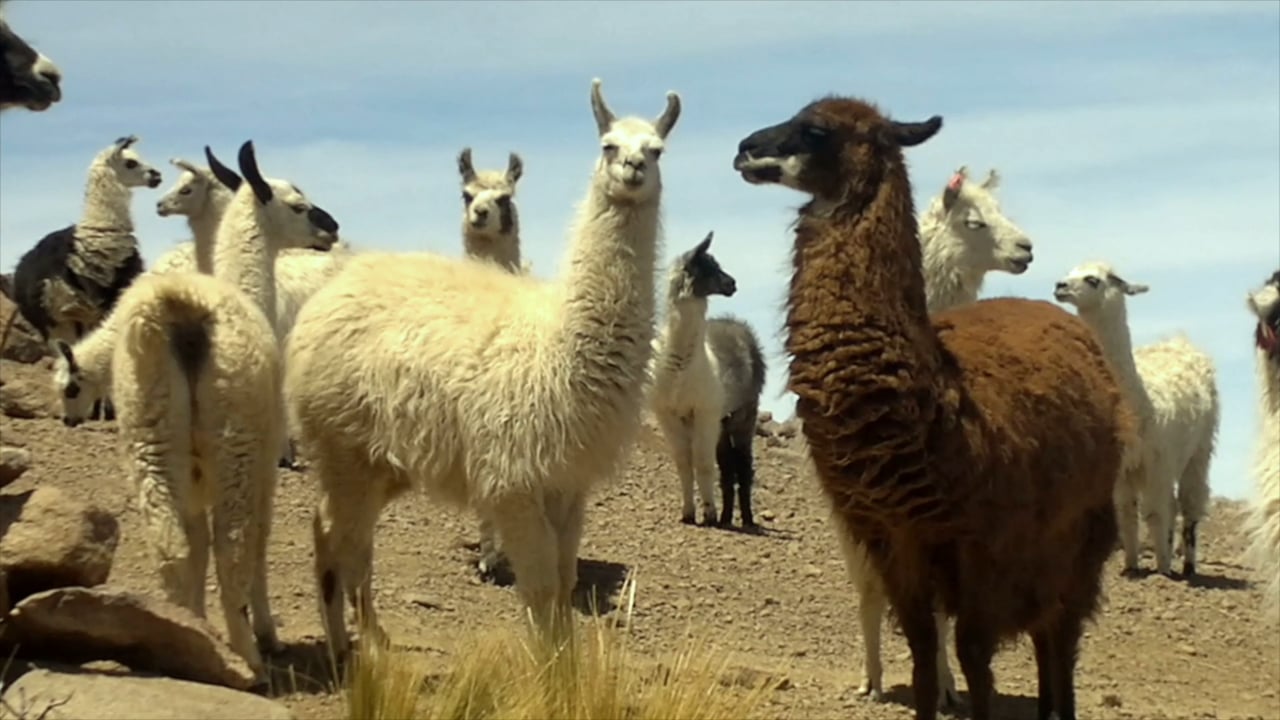
Is it in their spit? Both like to do that.
I don't have free access to the full text of the peer-reviewed article, other than via ILL or going to a brick-and-mortar library that subscribes to the journal individually or in a database, so I can't see what they used or the procedure.
Lafon, P. A., Prézeau, L., Pin, J. P., & Rondard, P. (2025). Nanobodies: a new paradigm for brain disorder therapies.
Trends in Pharmacological Sciences.
Here's a non-technical article about sourcing camelid nanobodies for researchers using yeast that may be of interest. Note the date (2018)
No Llamas Required
2018
"Detouring around a major research roadblock, researchers have found a new way to create valuable antibodies without needing … llamas?
It is a little-known fact that llamas, alpacas, camels and other members of the camelid family make a unique class of antibodies that allow scientists to determine the structures of otherwise impossible-to-study proteins in the body, helping them to understand how those proteins malfunction in disease and how to design new drugs that act on them.
As one might imagine, there are downsides to taking advantage of this evolutionary happenstance.
First, not all researchers who need camelid antibodies for their experiments have access to llama (or alpaca or camel) facilities. Second, while the animals are not harmed, vaccinating them to generate the desired antibodies is expensive, takes as long as six months per attempt and often doesn’t work.
So, biochemists
Andrew Kruse at Harvard Medical School and
Aashish Manglik at the University of California, San Francisco, teamed up to create a llama-free solution: vials of specially engineered yeast.
The yeast method, described Feb. 12 in
Nature Structural and Molecular Biology, can be done in a test tube in a researcher’s own lab. It has a higher success rate and faster turnaround time than both llama vaccination and previous attempts to circumvent camelids, the authors say.
It also marks the first time a camelid-bypass system has been made freely available for nonprofit use.
“There’s a real need for something like this,” said Kruse. “It’s low-tech, it’s a low time investment and it has a high likelihood of success for most proteins.”
“People who have struggled to nail down their protein structures for years with llamas are getting them now,” he said.
The active segments of camelid antibodies are often called nanobodies because they can be much smaller than regular antibodies. A llama nanobody might bind only to a particular conformation—for example, “open” or “closed”—of a particular protein. Nanobodies also can bind to challenging proteins, such as receptors that work in oily cell membranes.
Structural biologists like Kruse and Manglik want to find the exact nanobody that matches their protein of interest so they can lock the protein in one position and run tests to figure out its atomic structure. Learning the structure allows them to study how the protein works and provides a blueprint for designing drugs that target it."
More
Researchers develop alternate method to uncover protein structures, design new drugs

hms.harvard.edu
The above article links to the peer-reviewed article, which is not full text at the link target, but which is available full text via Google Scholar. This article describes the process (also from 2018) [opens directly to the pdf of the article on the National Institutes of Health (NIH) website]
C McMahon,
AS Baier, R Pascolutti,
M Wegrecki,
S Zheng, JX Ong, SC Erlandson,
D Hilger…
Nature structural & molecular biology, 2018•nature.com
Abstract
Camelid single-domain antibody fragments (“nanobodies”) provide the remarkable specificity of antibodies within a single 15 kDa immunoglobulin VHH domain. This unique feature has enabled applications ranging from use as biochemical tools to therapeutic agents. Nanobodies have emerged as especially useful tools in protein structural biology, facilitating studies of conformationally dynamic proteins such as G protein-coupled receptors (GPCRs). Nearly all nanobodies available to date have been obtained by animal immunization, a bottleneck restricting many applications of this technology. To solve this problem, we report a fully in vitro platform for nanobody discovery based on yeast surface display. We provide a blueprint for identifying nanobodies, demonstrate the utility of the library by crystallizing a nanobody with its antigen, and most importantly, we utilize the platform to discover conformationally-selective nanobodies to two distinct human GPCRs. To facilitate broad deployment of this platform, the library and associated protocols are freely available for non-profit research.



 www.goodnewsnetwork.org

 GOD!!!