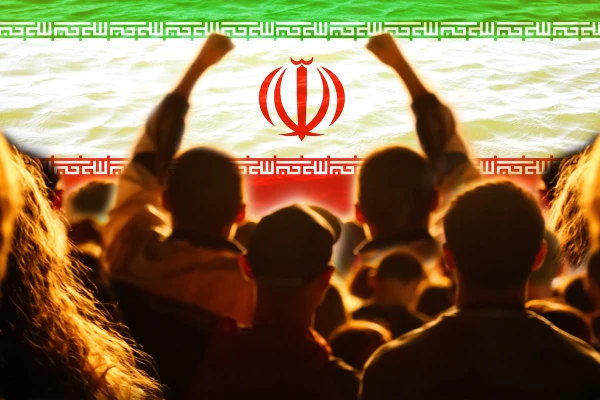
Iranian regime’s collapse a matter of ‘when,’ not ‘if,’ analyst says
Targeted assassinations by Israel and the combined U.S.-Israeli military pressure on Iran have set in motion an irreversible erosion of the Islamic Republic, opening the door for regime change, according to the research director of the National Union for Democracy in Iran.
“I don’t think we are dealing with an ‘if’ question,” Khosro Isfahani said in an interview. “The Islamic Republic will go regardless of the outcome of this military operation, of this war, regardless of what the United States and Israel decide tomorrow or the day after on how to continue this operation.”
In the opening hours of the war, Israeli airstrikes killed Supreme Leader Ali Khamanei in a dramatic first strike. In the weeks that followed, additional targeted killings eliminated senior figures, including National Security Council chief Ali Larijani, who had effectively become the country’s de facto leader.
While both roles have since been filled, Isfahani said the system has lost irreplaceable institutional knowledge and experience.
“Khamenei was irreplaceable. Same goes with someone like Ali Larijani,” he said. “Yes, they are going to appoint someone new to that position. Even if that new person survives 24 hours before the IDF takes him out, he is not going to be as competent, as knowledgeable, as tried and as trusted as Larijani was.”
The ayatollah’s son, Mojtaba who was appointed in his place possesses neither the same power nor systematic memory of his father, according to Isfahani. Moitaba has not made a public appearance since his appointment.
“Khamanei was not only powerful because he was a good orator or had been long at this game. He had accumulated four, five decades of experience under the Islamic Republic. He knew the system inside out. He knew every actor. He knew how to manipulate each of them, what buttons he should push to deliver a specific result,” he explained. “Mojtaba doesn’t have that. Any other candidate in the circle of senior clerics within the Islamic Republic doesn’t have that.”
Even with replacements being appointed, Isfahani said, the system itself is degrading.
“When you remove the central part, yes, another person from the outskirts will replace him. But it’s not going to be the same system,” he said. “And gradually when you remove enough individuals from the system, then it will collapse.”
He compared Israel’s targeted assassination tactic to changing broken parts of a vehicle.
“Every car carries some spare parts,” Isfahani explained. “But you cannot turn a personal vehicle, a whole government system, into a truck carrying spares. That's the same with the Islamic Republic.”
STRAIN ON SECURITY FORCES
Pressure is also affecting the regime’s security apparatus, he said, pointing to declining morale and reported defections among rank-and-file members of the Basij and Islamic Revolutionary Guard Corps (IRGC).
“We are seeing a mowing at the top, but it’s not limited there,” he said, citing strikes on militia forces and reports of desertions among the security apparatus. “The cost is increasing and the benefit is nosediving. So they are not showing up.”
Foot soldiers are less motivated by ideology than those at the top, Isfahani explained. And, now, supply disruptions and ongoing strikes have compounded the strain.
“A lot of them don't have even a place to show up to. And even when they do, even when they do, the regime doesn't have the capacity to give them money, food and water,” Isfahani said.
"Many calculate whether it is worth risking their lives for a regime that might fall. Some commanders have deserted their military posts and soldiers, knowing that the bases could be hit by the U.S. and Israeli airstrikes, sleep outside the base at night and return during the day."
CULMINATION OF DECADES OF PROTESTS
Isfahani said the societal unrest in Iran and protests that were brutally quashed in January represent a culmination of decades of resistance, not a sudden phenomena.
“Since the inception of this regime, Iranians have been fighting it,” he said, listing protest movements from 1979 to recent uprisings. “We are dealing with a population that, over the decades, has demonstrated that it doesn’t want the Islamic Republic.”
“We have been marching against this regime. We are going to keep marching,” he said.
He added that public sentiment has shifted away from religious governance.
“The majority of Iranians don’t want a religious state, don’t want an Islamic Republic,” he said. “The Islamic Republic has been an enemy of life for the past five decades and it’s going to be reduced to a blip in our long, long history.”
FUTURE VISION
Isfahani said the National Union for Democracy in Iran (NUFDI) was established to counter the Islamic Republic's lobbying and influence efforts in the West including the promotion of the Joint Comprehensive Plan of Action and sympathetic media coverage.
NUFDI supports exiled Iranian Crown Prince Reza Pahlavi to lead a post-regime vision centered on secular democracy and reintegration with the global community.
“We finally have reached the point that we have a leader that we trust,” he said.
He believes that is also the will of the Iranian people.
“On January 8th and 9th… according to intelligence that we have received from reliable sources, millions of Iranians were on the street chanting this man's name. It was very clear who they were, why they came out, who were they were supporting. And that was unprecedented,” he said.
“He has a deep sense of decency. And what we need in Iran is making Iran decent again,” Isfahani said.
Pahlavi’s leadership would stand in direct contrast to the brutality of the current regime, Isfahani said.
“We have been dealing with a bunch of thugs that have occupied my homeland for all these years, that have killed and raped and tortured my nation,” he said. “And finally, we have hope in a leader that has decency, is kind, is generous, and has a very clear vision for the future of Iran.”
Analyst says Iran’s regime collapse is inevitable as Israeli-U.S. pressure, internal erosion, and protests weaken the Islamic Republic.

allisraelnews.com


 worldisraelnews.com